
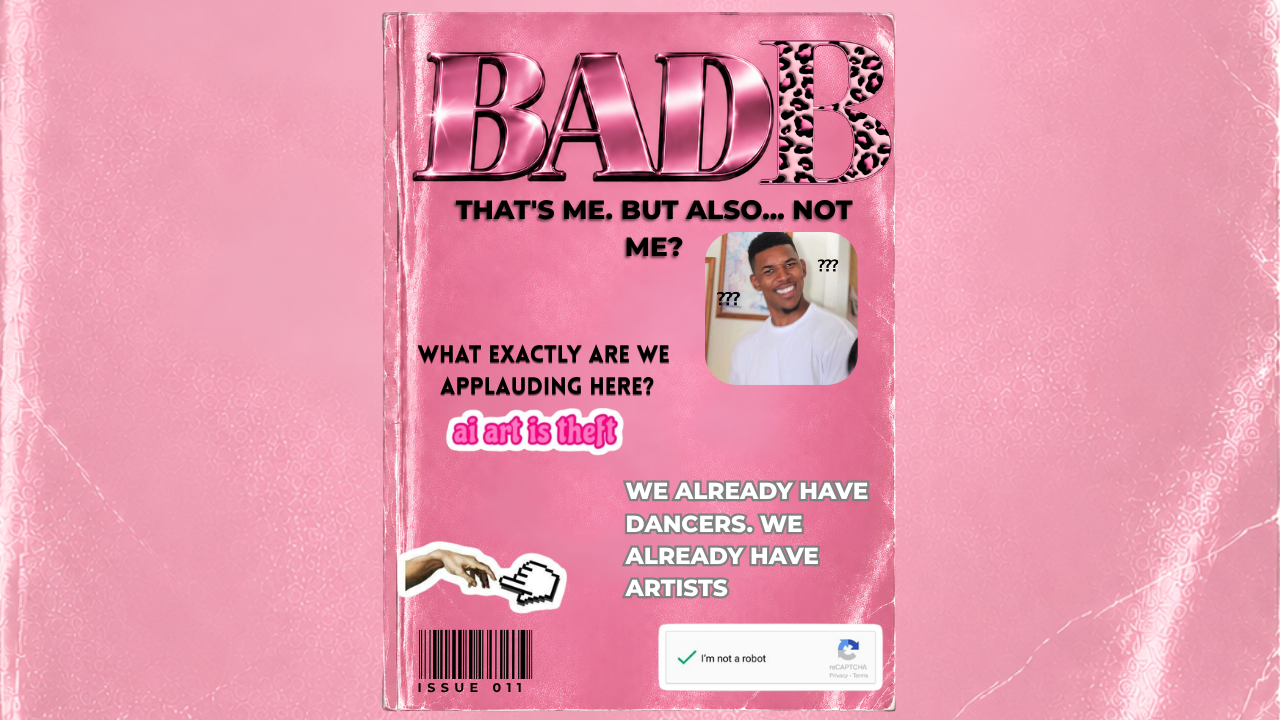
ISSUE 011- I GOT REPLACED BY A WOMAN WHO DOESN'T EXIST.
Oct 22, 2026AI, stolen creativity, digital women and the increasingly strange relationship we're developing with reality.
SOMEONE REPLACED ME IN MY OWN DANCE VIDEO.
A few weeks ago, one of my students sent me a video and asked, "Isn't this your choreography?"
I opened it, started watching and immediately recognised the movement. My first thought was something along the lines of, Wow, no credit? Thanks babe. Which, unfortunately, isn't exactly an unfamiliar experience when you work in the creative industry.
But then I looked a little closer.
Hang on.
That's not just my choreography.
That's ME. But also... not me?
Somebody had taken a video of me dancing and used AI to replace my appearance with an entirely different, digitally generated woman. The choreography was mine. The timing was mine. The movement was mine. The performance was mine. But the person everybody was watching wasn't me.
And I genuinely didn't know whether to laugh or be horrified.
Because what the actual fuck?
I then discovered that this wasn't simply somebody experimenting with technology and keeping the result to themselves. It had been posted publicly, and people were commenting on how well this digital woman could dance.
Even more bizarrely, the person running the account was responding to compliments as though this character had actually performed the choreography. At one point, they even suggested she'd done it better than me.
Sorry, SHE DID WHAT? 😭
I can take constructive criticism. I can appreciate another dancer interpreting my choreography differently. But being told that a computer-generated woman has outperformed me using footage of my own performance is a new one.
And whilst the whole situation was initially so ridiculous that I almost found it funny, the more I thought about it, the more uncomfortable it became.
Because this isn't just somebody copying a dance.
This is somebody taking the result of another person's physical labour, removing the person responsible for it and presenting the finished product as something new.
And that opens up a much bigger conversation.
YOU'RE NOT JUST STEALING 30 SECONDS OF CHOREOGRAPHY.
I think one of the biggest problems with how we consume creative content online is that we've become so accustomed to seeing the finished product that we forget everything that went into creating it.
You watch a thirty-second dance video. You see the outfit, the music, the choreography and the performance. You scroll, maybe leave a comment, and move on.
What you don't see is the years of training behind it.
You don't see the money spent on classes, workshops, travel, studio hire and education. You don't see the injuries, the frustration, the hours spent repeating movements until they finally feel right, or the days when you walk into a studio with absolutely no inspiration and somehow have to create something anyway.
You don't see the sacrifices people have made to develop their craft.
And that's not just dancers. It's musicians, photographers, illustrators, writers, actors, designers and practically anybody who has dedicated a significant part of their life to becoming good at something.
The finished product is not the entirety of the work. It's the result of the work.
So when somebody takes an existing performance, changes the face and body of the person in it and presents it as their own creation, they're benefiting from an enormous amount of human effort they never had to invest themselves.
And I think it's worth asking what happens when that becomes normal.
What happens when an account can build an audience from performances it never created? When somebody can potentially earn money, attention or opportunities using the work of people who never agreed to participate?
I'm not suggesting that every AI-generated video is automatically copyright infringement. The legal position depends on what's been used, who owns the rights and how the material has been reproduced. But legality and ethics aren't always the same conversation.
Just because technology gives you the ability to do something doesn't automatically mean you should.
And somewhere in all the excitement about what AI can create, I think we've become remarkably comfortable forgetting to ask whose work made that creation possible.
THE PATRIARCHY HAS ENTERED THE AI CHAT.
And this is where the conversation becomes particularly uncomfortable for me.
For generations, women have had their bodies policed, sexualised, criticised and controlled. We've been told how to dress, how to behave, how much skin to show, how much sexuality is acceptable and who that sexuality should exist for.
Now we've developed technology that allows people to manufacture digital women who can look, move and behave however their creators want.
And they're using the actual performances of real women to do it.
I find that genuinely disturbing.
Because think about what that means. A real woman can spend years developing her craft, film herself performing something she created, and somebody else can take that footage and digitally redesign her into their preferred version of a woman.
Different face. Different body. Different proportions. Whatever aesthetic they want.
The woman becomes replaceable. Her labour doesn't.
And there's a particularly uncomfortable irony in the way women's real bodies are so often scrutinised, censored or criticised online, whilst technology makes it increasingly easy to create artificial versions of women designed around somebody else's preferences.
We should be asking who benefits from these creations, who gets represented, who gets erased and who gets to decide what a woman's body should look like.
We've spent years fighting for women to have control over their own bodies. Are we really going to act like digitally manufacturing and manipulating them raises no questions at all?
WHEN DID WE STOP CARING WHETHER SOMETHING IS REAL?
Something else I found genuinely fascinating, and slightly terrifying, was the reaction from people watching the video.
Some viewers apparently couldn't recognise that the dancer wasn't real.
Others seemed perfectly aware that she was AI-generated and were still complimenting her dancing as though she had physically performed it.
And I just kept thinking, What exactly are we applauding here?
Because if you're complimenting the choreography, the musicality, the control or the performance, you're complimenting something that came from a real dancer.
The digital character didn't train. She didn't rehearse. She didn't make creative decisions about how to interpret the music. She didn't spend years developing the strength, coordination and muscle memory required to perform that choreography.
She was placed over somebody who did.
Of course, creating digital content can involve genuine technical and artistic skill. I'm not dismissing the people who work in animation, visual effects or digital design. But there's a difference between appreciating the technology used to create an illusion and attributing somebody else's physical achievements to the illusion itself.
And I think we're beginning to blur that distinction.
We've already become accustomed to heavily edited photographs, filters, manufactured lifestyles and carefully curated versions of reality. Now we're entering a world where the people we're watching might not even exist.
And somehow we're supposed to treat that as completely normal????
I'm so concerned by the psychological side of this. What happens to our understanding of beauty, talent, achievement and human connection when increasingly convincing digital people can be created to look and behave exactly how somebody wants?
What happens when we begin comparing ourselves not just to edited versions of real people, but to people who were never real in the first place?
We already know how damaging unrealistic expectations can be. Now imagine those expectations being built around bodies and lives that don't even have to obey the limitations of being human.
And perhaps most importantly, what happens when we become so obsessed with the appearance of talent that we stop valuing the experience required to develop it?
Because that's the part I find particularly sad.
THE ENVIRONMENTAL COST WE DON'T SEE.
And as if the ethical implications weren't enough, there's another part of the conversation that I don't think gets nearly enough attention.
The environmental impact.
AI isn't magic floating around somewhere in the internet. It relies on physical infrastructure, data centres, electricity, cooling systems, hardware and enormous amounts of resources.
And the overall demand for data centres is growing rapidly.
Which raises a question I think we should be asking more often:
Is every possible use of AI actually worth the resources required to produce it?
Using it to put a different woman's face over somebody else's dance video for Instagram engagement.... I'm sorry, but can we have a conversation about priorities? 😭
We need to stop treating the digital world as though it's somehow disconnected from the physical one.
Just because something happens on a screen doesn't mean it comes without a real-world cost.
ARE WE LOSING THE HUMAN BEHIND THE ART?
I think this is what the entire situation has made me reflect on the most.
We're developing technology that can imitate the results of human effort whilst increasingly treating the human effort itself as optional.
And dance feels like such a strange place for that to happen because dance is, by its very nature, a physical and human experience.
It's the relationship between your body, the music, your emotions and the audience.
It's the mistakes you make whilst learning something new. It's the frustration of not being able to execute a movement, followed by that incredible feeling when something finally clicks.
It's the way two dancers can perform the exact same choreography and somehow make it look completely different because of who they are.
It's the hours spent in a studio creating something that didn't exist before you walked through the door.
And sometimes it's the community that comes with it. The friendships, the shared experiences, the encouragement, the confidence people develop and the feeling of being part of something bigger than yourself.
Those things aren't just incidental details surrounding dance.
They're part of what makes dance meaningful.
And whilst technology can reproduce the visual appearance of a performance, it hasn't lived any of the experiences that made that performance possible.
I do think there's a difference between using technology to expand human creativity and using it to remove the human being from something they created.
And when we stop caring about that distinction, I worry about what else we're going to lose.
Because the value of art has never been solely about producing something visually impressive.
It's also about the person behind it.
The experiences that shaped them. The decisions they made. The emotions they wanted to communicate. The risks they took in putting something personal into the world.
I don't want to live in a world where we become so impressed by how convincingly a computer can imitate those things that we forget why they mattered in the first place.
PROGRESS SHOULDN'T MEAN MAKING PEOPLE DISPOSABLE.
We should probably question why we're so desperate to create artificial versions of things that already exist in the real world.
Because we already have dancers.
We already have artists.
We already have incredibly talented, creative, interesting human beings making things worth watching.
And they're not perfect. They make mistakes. They have limitations. They get tired, they struggle, they grow and they change.
That's part of what makes their work interesting.
I don't need a digitally manufactured woman to perform my choreography better than me.
I'd much rather watch another real dancer interpret it in a way I never would have thought of. Someone with their own personality, their own experiences and their own relationship with movement.
That's exciting to me.
That's creativity.
And if somebody wants to appreciate the choreography I spent years developing the ability to create, brilliant. That's one of the reasons I share my work in the first place.
But don't remove me from my own performance and then congratulate a fictional woman for doing it.
At the very least, let her choreograph her own bloody routine. 😭
Because ultimately, the problem isn't that technology can imitate art. It's what happens when we decide the artist no longer matters.
And I think that's a future worth questioning before we get too comfortable with it.
